田径女神走红
How technology boosts Beijing's air pollution governance_我的网站

一 |
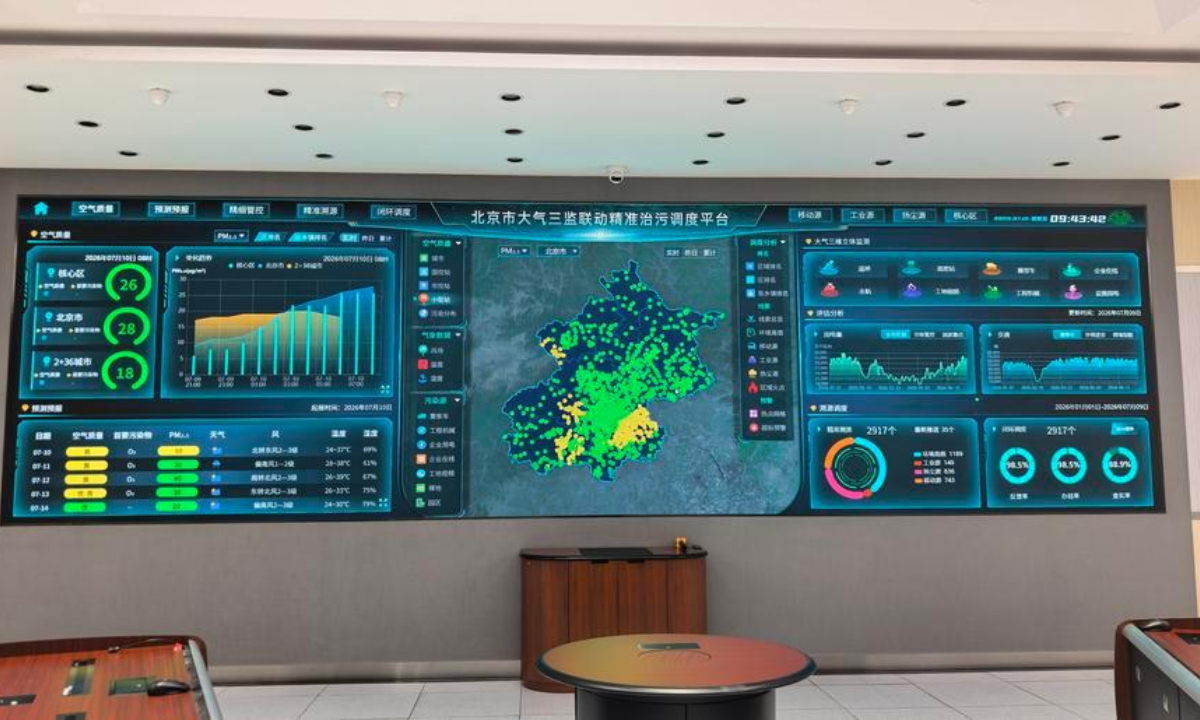
This photo taken on July 10, 2026 shows a data-driven environmental governance system, known as the innovative regulation-monitoring-inspection linkage model, showcased at the Beijing Municipal Ecological and Environmental Monitoring Center in Beijing, capital of China. (Xinhua/Sun Suying)Beijing's blue skies have become a visible sign of the city's progress in tackling air pollution, and behind that progress, digital technologies are playing an increasingly important role.
In 2025, Beijing recorded 311 days with good air quality and only one heavily polluted day, compared with 58 heavily polluted days in 2013, when the city officially began releasing PM2.5 monitoring data. The annual average PM2.5 concentration, a key indicator of air quality, fell from 89.5 micrograms per cubic meter in 2013 to 27 micrograms per cubic meter in 2025, a decline of nearly 70 percent.
The progress has drawn international attention. The United Nations Environment Programme has highlighted Beijing's experience in improving air quality as a model for other cities.
According to experts at the Beijing Municipal Ecological and Environmental Monitoring Center, the cleaner air is the result of a comprehensive system integrating environmental monitoring, scientific analysis, policymaking, regional cooperation and law enforcement -- with digital technologies now woven into every link of that chain.
MORE TARGETED APPROACH
Effective governance begins with accurate monitoring. Beijing has established a multi-level air-quality monitoring network. Figures show 35 standard monitoring stations across the city continuously measure six major pollutants, while more than 1,000 compact sensors deployed across communities and townships provide more detailed information on local air-quality variations.
The monitoring system was gradually built by the Beijing Municipal Ecological and Environmental Monitoring Center, one of China's earliest ecological and environmental monitoring institutions, responsible for monitoring Beijing's air, water, noise, soil environments and ecosystems.
The center has developed an analytical system that can identify around 125 components of PM2.5, covering most of its composition and helping researchers trace pollution sources.
"Source analysis helps us identify the major contributors to pollution at different stages, providing a scientific basis for policymakers to target key emission sources," said Li Yunting, technical director at the center.
Coordinated by the Beijing Municipal Ecology and Environment Bureau, the center has conducted four rounds of PM2.5 source analysis studies with other institutions, with results released in 2014, 2018, 2021 and 2025.
The latest analysis showed that regional transport contributed 57 percent of Beijing's PM2.5 pollution. Among local sources that accounted for the remaining 43 percent, vehicle emissions and residential sources represented the largest share of pollution, a distinctive characteristic of a major international metropolis.
The monitoring results have provided scientific support for a series of pollution-control measures. For example, Beijing has promoted new-energy vehicles to reduce transport emissions and adopted advanced techniques, including air-supported membrane structures, to control dust emissions. Meanwhile, coal combustion pollution, once a major contributor, has almost been eliminated and is no longer listed among the main sources, reflecting broader national efforts to reduce coal consumption, promote clean energy and upgrade heavily polluting industries.
With PM2.5 concentrations now at relatively low levels, further gains in air quality will depend on more targeted, science-driven approaches.
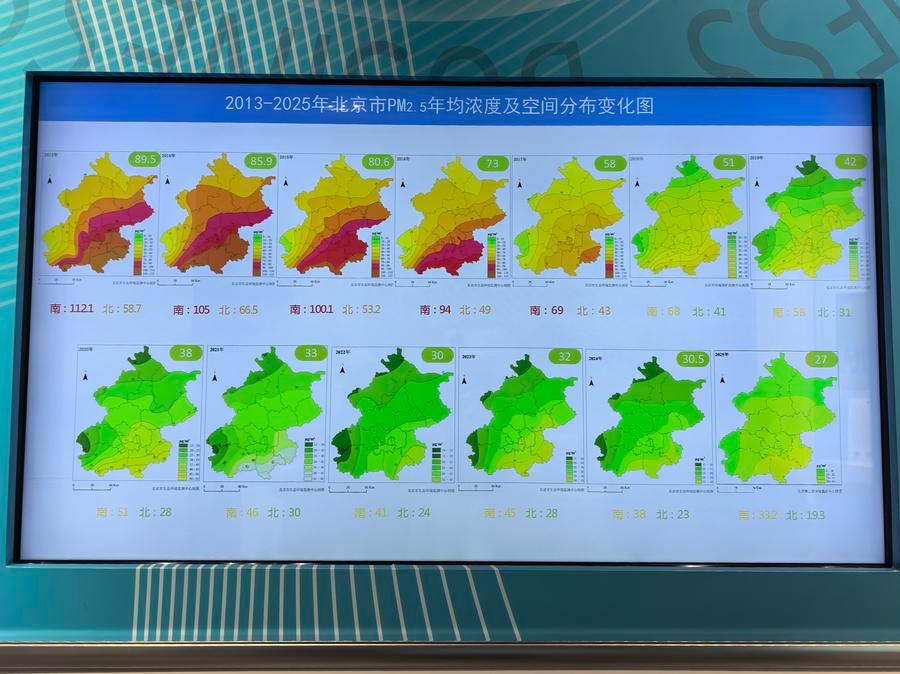
This photo taken on July 10, 2026 at the Beijing Municipal Ecological and Environmental Monitoring Center in Beijing, capital of China, shows the changes in the annual average concentration and spatial distribution of PM2.5 in Beijing from 2013 to 2025. (Xinhua/Sun Suying)
SMARTER ENVIRONMENTAL GOVERNANCE
Beyond monitoring pollution, Beijing has built a data-driven environmental governance system that links monitoring, regulation and enforcement in a closed loop from detection to action and follow-up evaluation.
Developed by the center and known as the innovative regulation-monitoring-inspection linkage model, the system integrates artificial intelligence, the Internet of Things, satellite remote sensing and vehicle-mounted monitoring technologies to pull together environmental data from multiple sources onto a unified platform.
"The system brings information that was once scattered across different departments onto a single platform," said Zhang Likun, director of the smart system division at the center, adding that this enables off-site enforcement and joint cross-sector actions involving housing, water resources and transportation, significantly improving the efficiency and precision of environmental management.
Using more than 30 intelligent algorithms, the platform automatically analyzes data and identifies potential pollution risks, based on which monitoring staff identify the most pressing problems and forward them to enforcement departments.
The approach has already drawn international attention. Clean Air Asia, an international nongovernmental organization focused on improving air quality across Asia, featured the system as a representative case study in its "China Air 2025" report. The model was also presented at the 2026 Better Air Quality Conference and recognized with the Certificate for Clean Air Best Practice Sharing.
China has integrated ecological conservation into its modernization drive. As the country speeds up efforts under the Beautiful China Initiative, Beijing's experience demonstrates how technology can support more precise, coordinated and sustainable environmental governance.
。 Britney Spears has furiously defended her right to upload various tantalizing naked snaps of herself to her social media pages.,Ever since her 13-year conservatorship at the hands of her father, Jamie, came to an end last year, the “Toxic” hitmaker has made a succession of photo dumps of nude photos on her official Instagram* account, often using a pink heart emoji to cover herself for modesty.,The songstress, 40, weighed in on some of the criticism, telling her over 42 million followers:,“Conservative Diplomatic Voice… I had everything but broken inside! I never wanted to be the girls who show their bodies! Bulls**t! Try being covered for 4 months with no keys. I have the right to express my body, mouth, eyes, heart and feet and show whatever I want.",Britney Spears' Nude Photo Dump on Social Media Triggers Concerns Pop Icon is 'Crying for Help'10 May, 06:28 GMT,The “Baby One More Time” vocalist who shares two teenage sons, Sean, 16, and Jayden, 15, with ex-husband Kevin Federline continued:,"My body was manipulated, abused, and torn by people, not my friends. I have beautiful friends who give me joy and lift my a** higher every day. If my shallow smile approach offends anyone which I only have learned to copy. So sorry! Psss come on icons, who we be fooling?!",Reflecting on her latest track, a remake of Hold Me Closer featuring Sir Elton John, she added:,"Psss bane if song is Hold Me Closer pssss own own own!",Britney Spears Posts Dramatic Slowed Down Version of her 1998 Single ‘Baby One More Time’18 July, 03:47 GMT,Fans praised the singer in the comments section for “coming back with a vengeance" and supported her by saying that she didn’t “owe the world sh*t.",Previously, Britney Spears even elicited reproach from Federline over her nude pics. Federline had claimed in a Daily Mail interview on August 6 that the boys had “decided they are not seeing her right now.” He alleged that the teens didn’t attend Spears’ June wedding to Sam Asghari because of her frequent nude Instagram* posts.,In response, in two now-deleted posts, Asghari, 28, blasted the accusation, penning:,“Even if there was truth to her kids being ashamed of their mothers choices and positive body image they wouldn’t be the 1st teenagers embarrassed of their parents. Most kids are embarrassed of their parents at one point. The mere presence of a parent can humiliate a teenager. It’s so common it has been a storyline used over and over on TV and in Films for decades.”,Asghari insisted that Spears was simply using the pics as a means of expressing herself now that her 13-year conservatorship has ended.,“Eventually if not already they will realize their mothers choices are harmless and an expression of newly found freedom. There is nothing to be embarrassed about just lots of things to be proud of,” wrote Asghari.,*Activity of Meta (Facebook and Instagram) is banned in Russia over extremism.。
Current article:http://zwu1h.sunaichitikouchua.bond/list_o249/f4w.html
Published on:00:15:50